
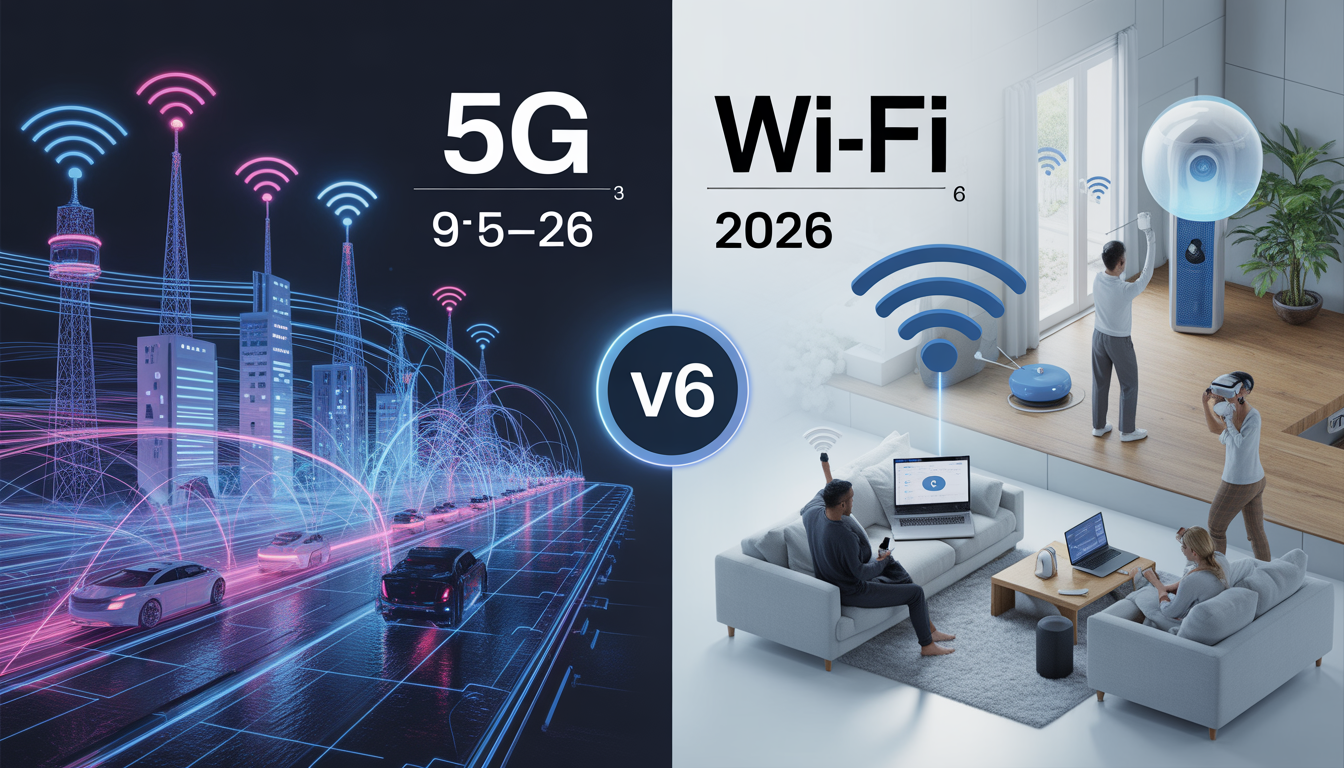
In today’s digitally driven world, reliable internet connectivity is more essential than ever. Two of the leading wireless technologies 5G and Wi-Fi 6 have transformed the way we connect to the digital universe. As we enter 2026, the competition between these two powerful connectivity options has become more prominent.
So, 5G vs Wi-Fi 6: Which is better in 2026? Let’s explore their features, differences, advantages, and the best scenarios to use each technology.
What Is 5G in 2026?
5G stands for the fifth era of versatile arrange innovation. It builds upon the capabilities of 4G LTE but offers much faster data transfer, more reliable service, and increased capacity.
Key Features of 5G:
- Exceptionally Fast Data Rates: Modern 5G networks in 2026 can reach peak download rates exceeding what was once possible with fiber connections.
- Minimal Latency: With response times as low as a single millisecond, 5G supports real-time applications like telemedicine, virtual reality, and autonomous driving.
- Better Support for More Devices: 5G can accommodate massive numbers of connected devices per square kilometer, making it ideal for smart cities and IoT ecosystems.
- Greater Geographic Reach: Advanced 5G infrastructure allows for broader, more stable outdoor coverage.
Popular Use Cases for 5G:
- Mobile streaming and cloud gaming
- Autonomous vehicle communication
- Real-time video surveillance
- Rural internet access with high speeds
What Is Wi-Fi 6 in 2026?
Wi-Fi 6, technically known as IEEE 802.11ax, is the latest iteration in the Wi-Fi family. It is designed to deliver superior performance in high-density environments, such as offices, stadiums, and smart homes.
Core Features of Wi-Fi 6:
- High Throughput for Multiple Users: Wi-Fi 6 enhances data flow, even in crowded environments filled with connected devices.
- Reduced Interference: By using technologies like MU-MIMO and OFDMA, it ensures better performance under heavy network load.
- Improved Energy Efficiency: Devices connected to Wi-Fi 6 can enjoy better battery life due to smarter communication methods.
- Robust Security: The introduction of WPA3 file encryption has elevated the safety and privacy of wireless connections.
Common Applications of Wi-Fi 6:
- Video streaming in smart homes
- Video conferencing in remote offices
- Connecting multiple IoT devices in one network
- High-bandwidth tasks like online learning and file sharing
5G vs Wi-Fi 6: Key Differences in 2026
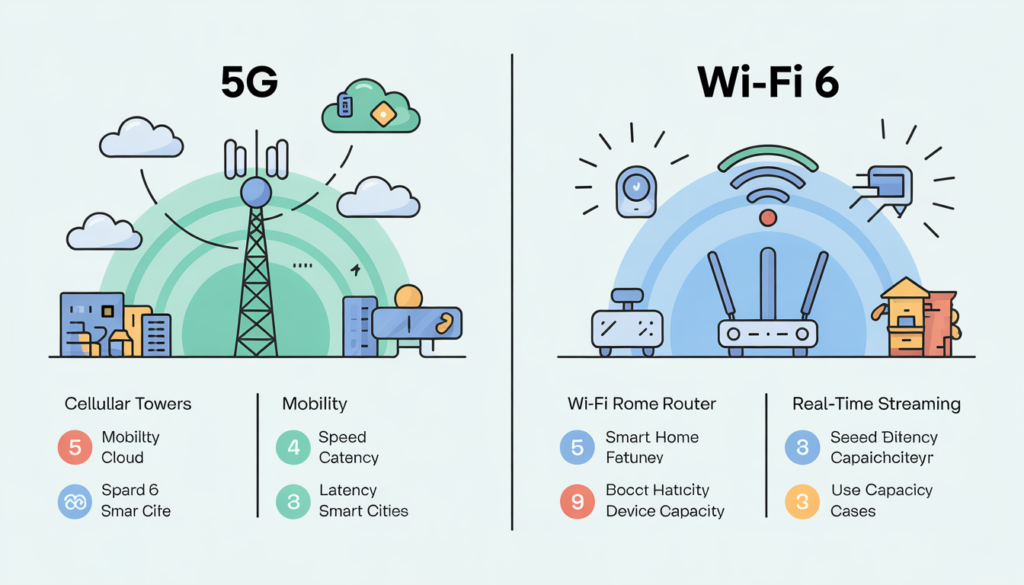
Here’s a detailed look at how both technologies compare in real-world usage as of 2026:
| Feature | 5G Mobile Network | Wi-Fi 6 Wireless Network |
|---|---|---|
| Deployment | Rolled out by telecom carriers | Installed locally via routers |
| Coverage Area | Large-scale, ideal for outdoor or travel use | Limited to indoor spaces or specific buildings |
| Download Performance | Capable of reaching multi-gigabit speeds | Delivers near fiber-level speeds in ideal setup |
| Latency | Can be as low as 1 millisecond | Typically ranges from 5 to 10 milliseconds |
| Device Handling | Supports up to 1 million devices per square km | Manages hundreds to thousands depending on setup |
| Mobility | Perfect for movement and wide-area roaming | Fixed, best when stationary |
| Cost | Requires mobile data plans or network subscriptions | One-time cost of router and broadband connection |
| Security Control | Managed by carriers | Fully customizable by users |
When Should You Choose Each?
Choose 5G If:
- You need reliable internet on the go—whether you’re traveling, commuting, or working remotely from various locations.
- Setting up wired broadband isn’t feasible, especially in rural or isolated locations.
- Your work or services depend on real-time communications, such as emergency services, robotics, or AR applications.
- You operate in areas with many mobile devices needing flexible and fast connections.
Choose Wi-Fi 6 If:
- You’re managing a smart home setup with dozens of connected devices.
- Your activities, such as gaming or video editing, require a stable high-speed local network.
- You’re running a business that depends on secure, controllable, and predictable internet within a building.
- You want to avoid mobile data charges by leveraging fixed-line broadband.
Can 5G and Wi-Fi 6 Work Together?
Yes not only can they coexist, they actually complement each other in many environments.
In a modern setup, smartphones, laptops, and other gadgets are equipped to toggle between 5G and Wi-Fi 6 depending on availability, signal strength, and desired use.
Practical Examples:
- A workplace uses Wi-Fi 6 for indoor networking and relies on 5G for employees in the field.
- A smart home automatically switches mobile devices to Wi-Fi when indoors, saving on mobile data.
- Public spaces like airports or campuses use both technologies to ensure uninterrupted internet access.
As 2026 progresses, providers and device manufacturers are focusing more on seamless integration, allowing users to enjoy the best of both worlds without noticing network transitions.
The Verdict: 5G vs Wi-Fi 6 in 2026 – Which One Wins?
There is no clear winner between 5G and Wi-Fi 6, because both technologies are built for different purposes.
- If your priority is mobility, wide coverage, and real-time responsiveness, then 5G is the superior choice.
- If your focus is on local networking, cost-efficiency, and smart device control, Wi-Fi 6 is the better option.

Most individuals and organizations will benefit from a hybrid strategy that uses both 5G and Wi-Fi 6, depending on the task and environment.
Frequently Asked Questions (FAQs)
Q1: Can 5G replace Wi-Fi 6 completely?
A: Not quite. While 5G offers incredible mobility, Wi-Fi 6 excels in indoor setups and remains more cost-effective for local heavy internet usage.
Q2: Is Wi-Fi 6 enough for gaming and streaming?
A: Absolutely! Wi-Fi 6 provides excellent stability and bandwidth for gaming, 4K streaming, and VR—especially on fiber-backed connections.
Q3: Will Wi-Fi 7 and future 5G versions affect this comparison?
A: Yes, innovations like Wi-Fi 7 and 5G Advanced will deliver even better performance. However, in 2026, 5G and Wi-Fi 6 remain the most widely adopted technologies.